
Why You Should Come To a Workout Class
Most people who want to get stronger have a plan. The plan is reasonable: find some time in the week, get to the gym, do some stuff, go home. Repeat.
The trouble is that this plan almost never survives contact with reality — and when it does, it often doesn't produce the results people are expecting. Not because the goal is wrong. Because the approach has some structural problems that are well-documented in the research and almost universally underestimated.
If you have goals that would benefit from strength training (health, longevity, athletic performance, supporting endurance sports, reducing injury risk, etc) but think “I’m not a group class person,” here's what the evidence actually says.
Spoiler: Individuals who regularly go to workout classes are more consistent, have better results with less training, learn and refine movement technique, and build social connections. What are you waiting for?
The Gym Plan That Lives in Your Head
Intending to exercise and having a specific, protected time to exercise are not the same thing. People who commit to a particular day and time — who treat training like a scheduled appointment rather than something they'll get to when things slow down — follow through at dramatically higher rates than those who don't.
A class handles this automatically and also helps with accountability. There's a time on the calendar that you commit to. That's not a gimmick — it's just how structure works. Having a coach and a group at 6 a.m. expecting you is functionally different from having a general intention to train sometime Tuesday. One of them reliably happens. The other one usually doesn't.
You're Probably Not Working Hard Enough
Here's something that gets confirmed repeatedly in research and that any experienced coach could tell you from observation: people left to their own devices don't train at a difficulty level that produces meaningful results.
This isn't about motivation. It's about calibration. For strength and muscle adaptations to occur, training intensity generally needs to reach around 60–75% of your maximum effort on a given exercise. In two well-designed studies, novice lifters self-selecting their training loads landed between 40–57% of their maximum — consistently below the necessary threshold — despite rating the effort as "somewhat hard."¹·² They weren't slacking. They just had no way of knowing they weren't working hard enough to get where they wanted to go.
Coaching changes this. In peer-reviewed studies, coaching or personal training is typically called “supervision.” A 2000 study comparing supervised and unsupervised resistance training programs found that the supervised group trained at significantly heavier loads across the 12-week period — and finished with meaningfully greater squat and bench press strength as a result.³ A 2014 study at a Southern California fitness club randomized members to either supervised, periodized training or self-directed training. The self-directed group completed about 15% more volume. Despitetraining more frequently, the unsupervised group had poorer results. They gained significantly less lean muscle mass, less strength, and less aerobic fitness than the coached group.⁴ More time in the gym. Less to show for it.
A good coach doesn't just push you harder. A coach calibrates what "working hard" actually looks like for your body, on this exercise, at this point in your training — and adjusts in real time when it's not right.
Strength Training Is a Skill, Not Just an Activity
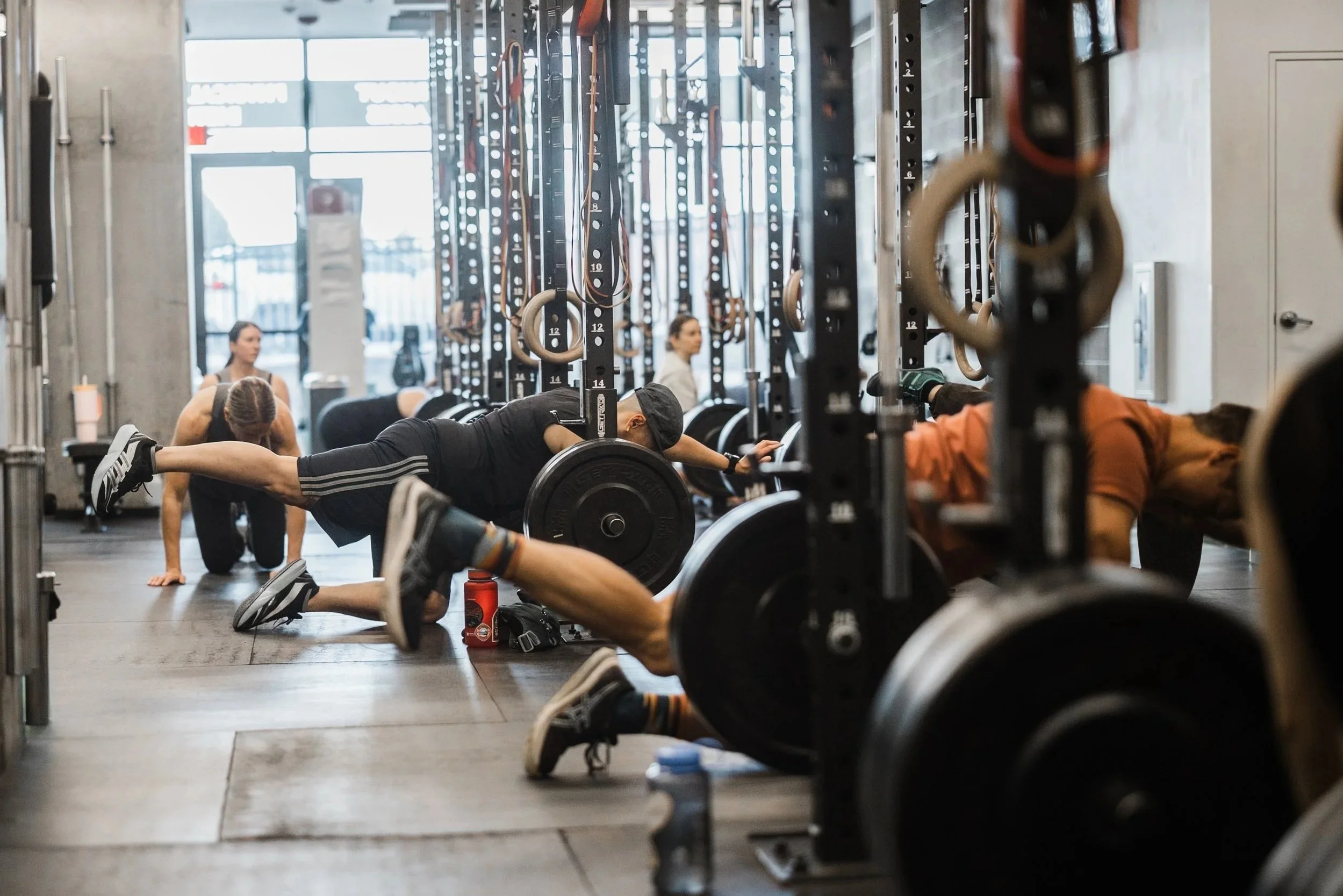
The fitness industry tends to underplay how much skill is involved in learning to train well. Squatting, hinging, pressing, pulling — these are technical movements. They require coordination, body awareness, and ongoing feedback to develop correctly. While it is completely safe for most adults to get started training on their own, assistance is helpful to continue making sustainable progress.
Research on exercise selection for novices confirms that expert guidance in choosing and cueing movements significantly affects both learning and safety.⁵ There's also some fascinating researching showing that people exercising together spontaneously synchronize their movement patterns and even their breathing — a kind of unconscious mutual calibration that supports skill acquisition and collective effort.⁶
In a coached class, you get expert eyes on your movement. More importantly, you get corrections in the moment — before a poor pattern becomes a habit or causes pain or injury. When an exercise doesn't work for your body on a particular day — an old knee issue, a shoulder that's been flaring up — a good coach adjusts on the spot. That's not a special service. That's what coaching looks like.
You'll Stick With It Longer
The other thing the research is consistent about: people who exercise in groups, with a coach, stick with it significantly longer than people who exercise alone.
Roughly half of people who begin an exercise program stop within six months.⁷ Group cohesion — feeling connected to the people you train alongside and invested in a shared goal — is one of the strongest predictors of continued participation.⁸·⁹ One study found that exercisers who formed close relationships through their training program were nearly six times more likely to keep coming back than those who didn't.¹⁰
A study out of Flagstaff’s very own Northern Arizona University found that small-group training that meets participants' core psychological needs — feeling competent, connected, and genuinely self-directed — predicts not just adherence to training but broader improvements in life satisfaction and energy.¹¹ When group exercise programs were compared to home-based programs over longer time horizons, the results were stark: at a six-month follow-up, 89% of group exercisers were still meeting recommended activity guidelines, compared to 48% of home exercisers.¹²
People often imagine they'll be more consistent training on their own — no schedule to coordinate, no one watching, full flexibility. What usually happens instead is that they just stop training at all.
You're Underestimating How Much You'll Enjoy It
If you're skeptical about group classes, you're in good company. And your skepticism may owe more to a known psychological bias than to accurate self-prediction.
Research on affective forecasting — our ability to predict how we'll feel about future experiences — shows that people consistently underestimate the positive value of social activities before they happen. In a series of nine experiments, participants predicted they'd have a more positive and productive experience alone, and then reported the opposite after actually spending time with others.¹³ We're reliably bad at anticipating what connection with other people actually feels like.
This is worth knowing, because the decision not to try a group class is often made before the experience. The prediction feels accurate. The data suggests it usually isn't.
It's also worth being direct about something: the U.S. Surgeon General's 2023 advisory identified loneliness and social isolation as a genuine public health crisis. About half of American adults reported meaningful loneliness even before the pandemic; poor social connection increases the risk of heart disease, stroke, and cognitive decline significantly.¹⁴ Exercise is one of the most natural contexts for building real social connection. If you're going to invest time in something good for your health, doing it alongside other people is doing two good things at once.
Men - We Need to Talk
Men are statistically less likely to seek help with their health across the board — about a third less likely to see a doctor, more likely to wait out symptoms, and culturally more likely to treat group participation as something other people do.¹⁵ The "I'm not a group class person" identity tends to run especially strong among men.
It's worth examining where that identity comes from. Group fitness has historically been marketed more towards women than men— that's real. But a well-programmed strength class built around compound lifts, progressive overload, and competitive effort in a supportive room has nothing inherently gendered about it. What it does have, based on the research, is better outcomes.
Who Actually Doesn't Need a Class
To be fair: there is a person who doesn't really need a coached group environment. That person has trained independently for years, genuinely understands and enjoys the process of designing and managing their own programming, is confident in their movement technique even at a high intensity, can adapt their workouts if something feels off, and can push to a high level of effort without external support.
The person who might not need a group class is the person who doesn't need music or company to stay motivated, and would train just as hard in a cold garage at 6 a.m. in the winter with no one watching as they would anywhere else. These people do exist, but they’re rare. And, even this person would probably enjoy the social connection that a group class provides!
Most people — including many who are certain they prefer to train alone — do measurably better with a coach and a group. The research on this is not subtle.
What If My Schedule Doesn’t Work With Classes?
Some people genuinely can't make a fixed class schedule work — demanding jobs, shift work, kids, travel. If that's you, the argument above still applies, just in a different form.
If your schedule is that packed, you're exactly the kind of person who likely needs external structure to stay consistent. A full calendar is precisely the environment where a loosely-held intention to "get to the gym when I can" disappears. The solution isn't to exercise without structure — it's to find a structure that actually fits your life.
For most people in this situation, we recommend personal training — typically four sessions per month as a starting point. A trainer can usually work around your schedule in ways a set class time can't, while still providing accountability, real programming, and coaching that adapts to what's going on with you. At EVOLVE, personal training packages also include open gym access and classes, so your training sessions become the anchor — a fixed, protected commitment — and everything else fills in around them.
There's a reason many people with genuinely demanding lives work with a personal trainer or coach. It's not just about affordability; it's about recognizing that consistency requires structure, and that structure is harder to maintain on your own when life gets complicated.
You Don't Have to Be Ready First
Before someone tries a class, we often hear, "I need to get in better shape first."
The logic is backwards. The class is where you get in better shape. That's the whole point.
At EVOLVE, our classes are designed to work across experience levels — from people who have never touched a barbell to athletes who've been training for years. In an EVOLVE Strong class, programming is the same for everyone, but loads and modifications are individualized. If you have injuries, chronic conditions, or a lot of anxiety about walking into a gym environment, our Foundations program exists specifically for that transition.
The gap between where you are now and "ready to start" isn't a gap you close on your own first. It's a gap you close by starting.
If you've been thinking about it, come try a free class. Worst case, you confirm it's not for you. Based on everything above, that seems pretty unlikely.
References
Glass SC, Stanton DR. Self-selected resistance training intensity in novice weightlifters. J Strength Cond Res. 2004;18(2):324–327.
Ratamess NA, Faigenbaum AD, Hoffman JR, Kang J. Self-selected resistance training intensity in healthy women: the influence of a personal trainer. J Strength Cond Res. 2008;22(1):103–111.
Mazzetti SA, Kraemer WJ, Volek JS, et al. The influence of direct supervision of resistance training on strength performance. Med Sci Sports Exerc. 2000;32(6):1175–1184.
Storer TW, Dolezal BA, Berenc MN, Timmins JE, Cooper CB. Effect of supervised, periodized exercise training vs. self-directed training on lean body mass and other fitness variables in health club members. J Strength Cond Res. 2014;28(7):1995–2006.
Kompf J, Rhodes RE, Lee S. Resistance training for health: expert consensus on appropriate exercise selection for novice practitioners. Am J Lifestyle Med. 2022;17(2):216–228.
Codrons E, Bernardi NF, Vandoni M, Bernardi L. Spontaneous group synchronization of movements and respiratory rhythms. PLoS ONE. 2014;9(9):e107538.
Maher JP, Gottschall JS, Conroy DE. Perceptions of the activity, the social environment, and the self predict attendance at fitness classes. Front Psychol. 2015;6:1236.
Dunlop WL, Falk CF, Beauchamp MR. How dynamic are exercise group dynamics? Examining changes in cohesion within class-based exercise programs. Health Psychol. 2012;32(12):1240–1243.
Maher JP, Gottschall JS, Conroy DE. (see ref. 7)
Christensen U, Schmidt L, Budtz-Jørgensen E, Avlund K. Group cohesion and social support in exercise classes: is it possible to reduce dropout rates? Health Educ Behav. 2006;33(2):258–273.
Wayment HA, McDonald J. Small group exercise and self-evaluated health, energy, and life satisfaction: evidence from a quasi-experimental study. J Strength Cond Res. 2017;31(10):2653–2660.
McCarthy EK, Horvat MA, Holtsberg PA, Wisenbaker JM. Repeated muscle strength measurements and the role of adherence in maintenance of strength over time in older adults. J Gerontol A Biol Sci Med Sci. 2004;59(8):M827–M834.
Epley N, Schroeder J. Mistakenly seeking solitude. J Exp Psychol Gen. 2014;143(5):1980–1999.
U.S. Department of Health and Human Services. Our Epidemic of Loneliness and Isolation: The U.S. Surgeon General's Advisory on the Healing Effects of Social Connection and Community. 2023. https://www.hhs.gov/surgeongeneral/reports-and-publications/connection/index.html
Sandman D, Simantov E, An C. Out of Touch: American Men and the Health Care System. Commonwealth Fund Men's and Women's Health Survey Findings. 2000.