
When Did You Last Jump? Why Reactive Movement Belongs in Every Active Adult's Training
Think back through the past week. Did you jump? Not step up onto something — actually jump, with both feet leaving the ground at the same time? Did you shuffle sideways quickly, change directions at the last second, or react to something that moved unexpectedly? If you did, was it intentional, or a rare occurrence that caught you off guard?
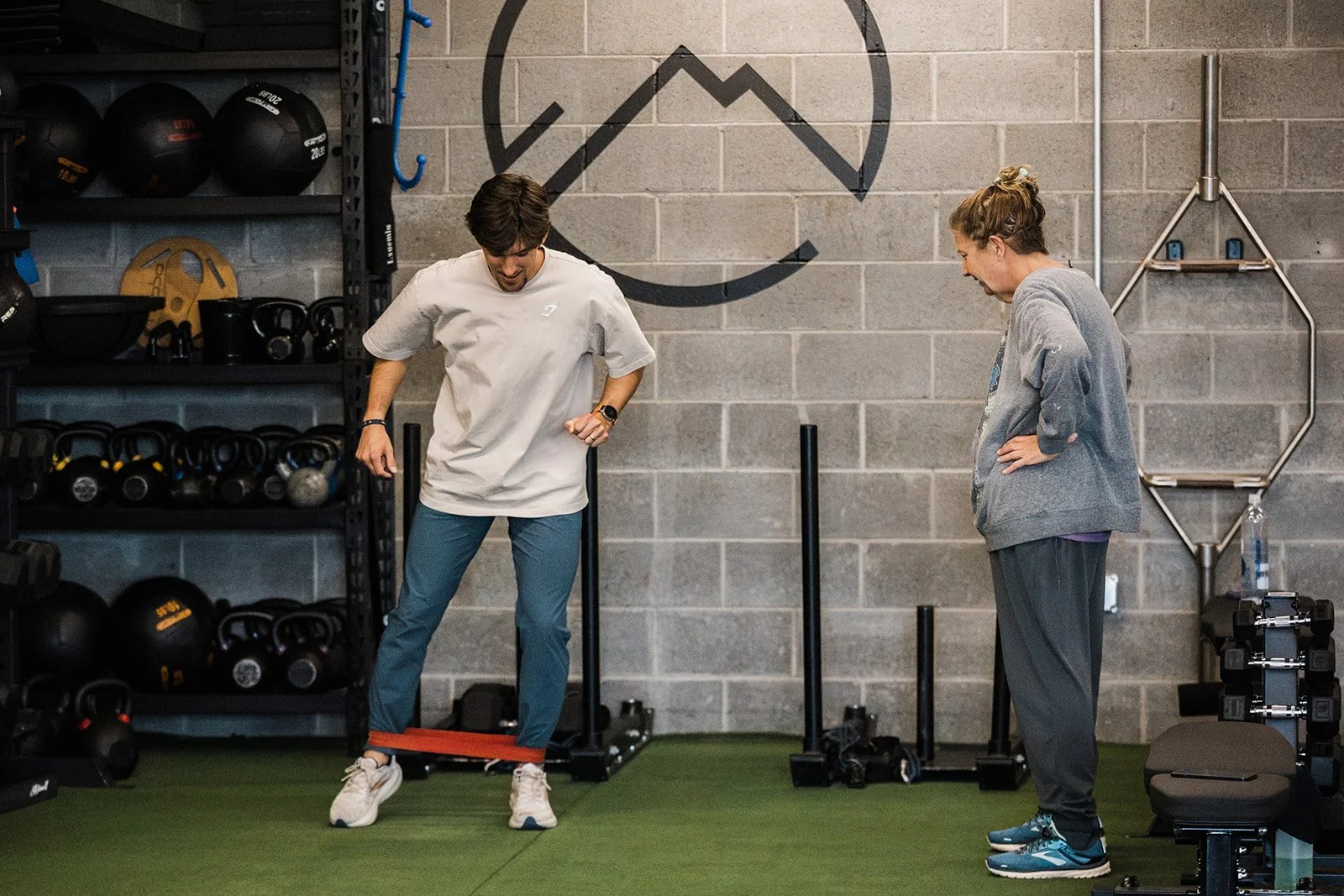
Haven’t jumped in a while? You can start at a level that’s right for you — often just learning to move in different directions
For most active adults, the honest answer to those questions is no. And the uncomfortable part is that this usually has nothing to do with fitness level. You might run, bike, hike, lift, or swim. You do physically demanding things. But the specific capacity to move fast, react quickly, and absorb force from unpredictable directions is a skill — and it quietly fades from most adults' lives not because something broke down, but simply because nothing in their routine asks for it anymore.
It disappears gradually, without announcement. You don't notice until life demands it — and then things can go wrong. You don't move as quickly as you expect. You tweak something with a seemingly innocuous movement and feel like your body is more fragile than it should be. Or worse. Catching your toe and stepping quickly to catch yourself is essential to preventing a fall, and falls become a significant source of injury and disability as we age.
Reactive movement — jumping, hopping, changing direction — is an essential part of not just athletic training, but of training to live and move confidently at any age.
Why This Skill Goes Missing
The activities that define Flagstaff's active adult culture — trail running, mountain biking, climbing, swimming, triathlon — are genuinely excellent for your health. They build aerobic capacity, muscular endurance, and mental toughness. But with a few exceptions, they're largely one-dimensional. They don't require rapid change of direction. They don't involve jumping and landing. They don't train your nervous system to process a visual cue and produce a fast, accurate movement in response.
Conventional strength training isn't much better on this front. Squats, deadlifts, and presses are valuable — genuinely valuable — but they're slow, predictable, and linear. Nothing about them resembles what your body has to do when the trail gets technical, when something surprises you on a descent, or when you jump into a rec softball game and realize your joints have feelings about that decision.
There are countless specific plyometric and reaction exercises. If this one looks a bit intimidating, rest assured there are accessible entry points for everyone.
What Are Reactive and Plyometric Movements?
Reactive and plyometric movement covers a range of things: jumping and landing, hopping on one foot, lateral shuffles and cuts, bounding, and direction changes in response to a visual cue. These movements share a common thread — they require your nervous system to generate or absorb force rapidly, in directions and at speeds that straight-line training doesn't prepare you for.
This is a large part of what "feeling athletic" actually means. Not strong, not cardio-fit — athletic. Responsive. Light on your feet. Confident that your body will do what you need when the ground shifts or the demand arrives without warning. That quality is trainable. It's also something we lose without specific attention. (Read more about why many adults don’t feel athletic as they age.)
One important note: these movements are scalable to any level. Not ready to jump? Start with quick pulses on your toes, skipping, or jumping jacks. Not ready to jump laterally on one leg? Start with a side shuffle — just like soccer practice in middle school. There's a reason almost every sports team, including track and cross-country, includes exercises like these in training. They work, and they meet you where you are.
Why It Matters
Being light on your feet on technical trail isn't purely a strength question. It's a reaction question. Rock hopping in a canyon, loose scree on the way to a summit, roots at mile 18 of a run — these require your body to process visual input and produce a fast, appropriate response. Joints, tendons, and the nervous system all participate. All of them can be trained for this. All of them deteriorate when they're not.
There's also the more ordinary version. A dog that cuts in front of you. A kid who changes direction suddenly. Catching yourself when you slip on ice. Jumping into a casual sport with confidence rather than anxiety. None of these require elite athleticism. They require a body that's been asked to move in multiple directions, at least occasionally.
And then there's what these movements do for orthopedic health specifically.
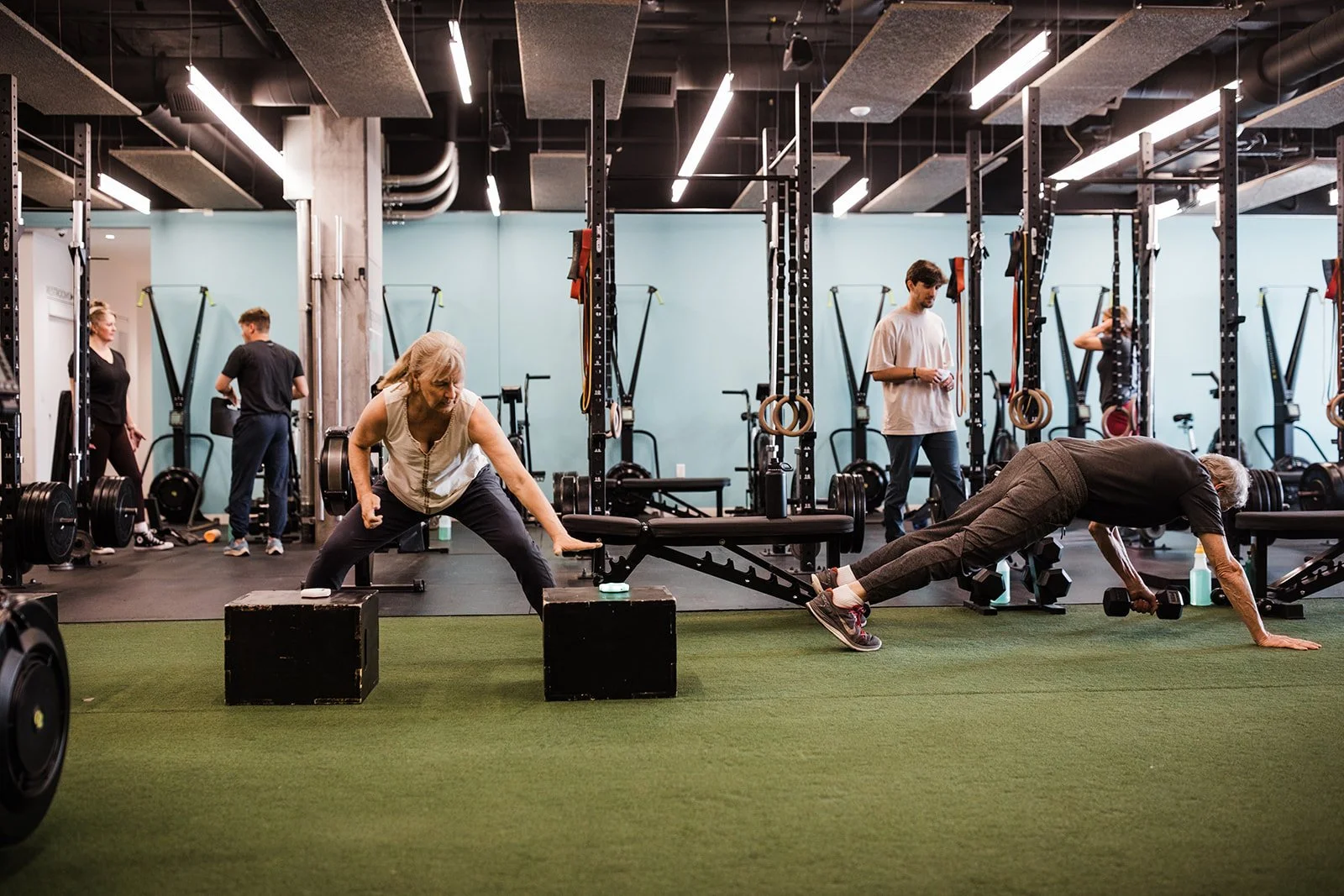
Using a system like the Forza reaction lights can make practicing reaction and agility both effective, and a lot of fun.
Bones. Jumping and moving quickly in different directions are among the strongest stimuli for building and maintaining bone density, helping to reduce osteoporosis risk. For those who already have osteoporosis or osteopenia, these movements can be scaled appropriately and are still bone-building.
Tendons. Tendons connect muscle to bone, and quick movements place significant load on them. If they haven't been trained for that demand, even a modest dose — coaching a kid's soccer game, a short hike with rock-hopping — can leave them sore or painful. Progressive exposure keeps them ready.
Joints. Modern understanding of joint health has largely overturned the idea that impact forces "wear out" cartilage. Joint tissues don't have their own blood supply; they get nutrition from the synovial fluid in the joint, which is stimulated by movement — including impact. Joint pain from these movements is usually a dosage issue (too much too soon) rather than a problem with the movements themselves.
Finally, moving quickly and in different directions builds a quiet kind of movement confidence. When your nervous system knows it can react, it relaxes. Think about walking on an icy surface: the fear of falling makes you tense and rigid, which actually makes you less safe. If you've gradually lost the ability to move quickly and reactively, your nervous system can start to operate as if you're always on thin ice — even when you're not.
Looking to start incorporating jumping and reactive movements into your training? Try your first EVOLVE Strong class for free. We work on these movements in every class.
What the Research Supports
Bone health. A 2014 meta-analysis found that regular jumping exercise significantly increased hip bone density — particularly at the femoral neck and trochanter, two sites central to osteoporosis-related fracture risk. The lumbar spine showed less response, which researchers attributed to how ground-reaction forces travel through the body. The underlying principle holds broadly: bones adapt to the demands you place on them, and predictable, low-impact movement doesn't provide much stimulus.
Tendons and connective tissue. Tendons load differently in a jump landing than in a squat or a steady run. They adapt specifically to the demands you train. Progressively exposing these tissues to reactive, multi-directional loading builds a kind of resilience that other training doesn't replicate.
Reaction time and injury prevention. Research in athletic populations suggests that slower reaction time is associated with meaningfully higher risk of lower extremity sprains and strains — in one study, more than twice the injury risk. Training that challenges your response to visual cues — reacting to light targets as they appear, for example — may help maintain the neural processing speed that keeps you protected when something happens faster than you expected.
The Piece That Often Gets Skipped in Rehab
In physical therapy, most of the work involves getting out of pain, restoring basic mobility, and rebuilding foundational strength and movement patterns. That work is real and necessary. But the final layer — reactive, multi-directional, speed-and-response movement — gets left out more often than it should.
The result is that many people who've been through rehab feel mostly fine but not entirely confident. They've rebuilt the foundation but didn't finish the structure. Jumping, cutting, and reacting to unpredictable demands represents something close to a return-to-life test. It answers the question: am I back, or am I just mostly back? EVOLVE’s physical therapy process aims to build to these movements as the injury heals.
It’s easier to Start Lower Than You Think
Shuffling drills, such as a side shuffle, are an excellent entry point to plyometric and reactive training.
You don't need to jump high, move like you did at 22, or impress anyone. For most adults, doing these movements at all — any version of them — is more neural stimulus than their body has seen in years.
Box jumps can start as a small hop off the ground. Single-leg hops can begin as tiny, controlled skips. Agility drills can be slow shuffles around a cone. The adaptation begins when you ask the question at all. The threshold isn't performance. It's exposure.
EVOLVE Strong Challenge: Vertical Jump + Reaction Time
One of our monthly challenges in our EVOLVE Strong program includes two tests: vertical jump height and reaction time using our Forza light system, where targets appear in random sequences and you respond as quickly as you can. No pass/fail. No comparison to anyone else. Just an honest look at a quality of physical capacity that most people haven't measured — or trained — in years.
The tests are a prompt, not a verdict. A way to make visible something that usually stays invisible until it becomes a problem.
If this is something you want to build, EVOLVE Strong integrates reactive movement into the Resilience block of every class — coached, progressive, and scaled to where you are. Come try a free class and start moving in new ways.