January 2026: Build Your Base
It probably won’t surprise you that we’re not big fans of New Year’s resolutions at EVOLVE. We’re all for intentional self-improvement—and for using the winter season and turning of the year as a time to pause, reflect, and chart a course for what’s ahead. Interestingly, some historians trace versions of this practice back thousands of years.
What we’re not for is the way that modern diet and fitness culture has co-opted a positive reflective practice and injected it with shame, guilt, and negativity.
So what do we do instead?
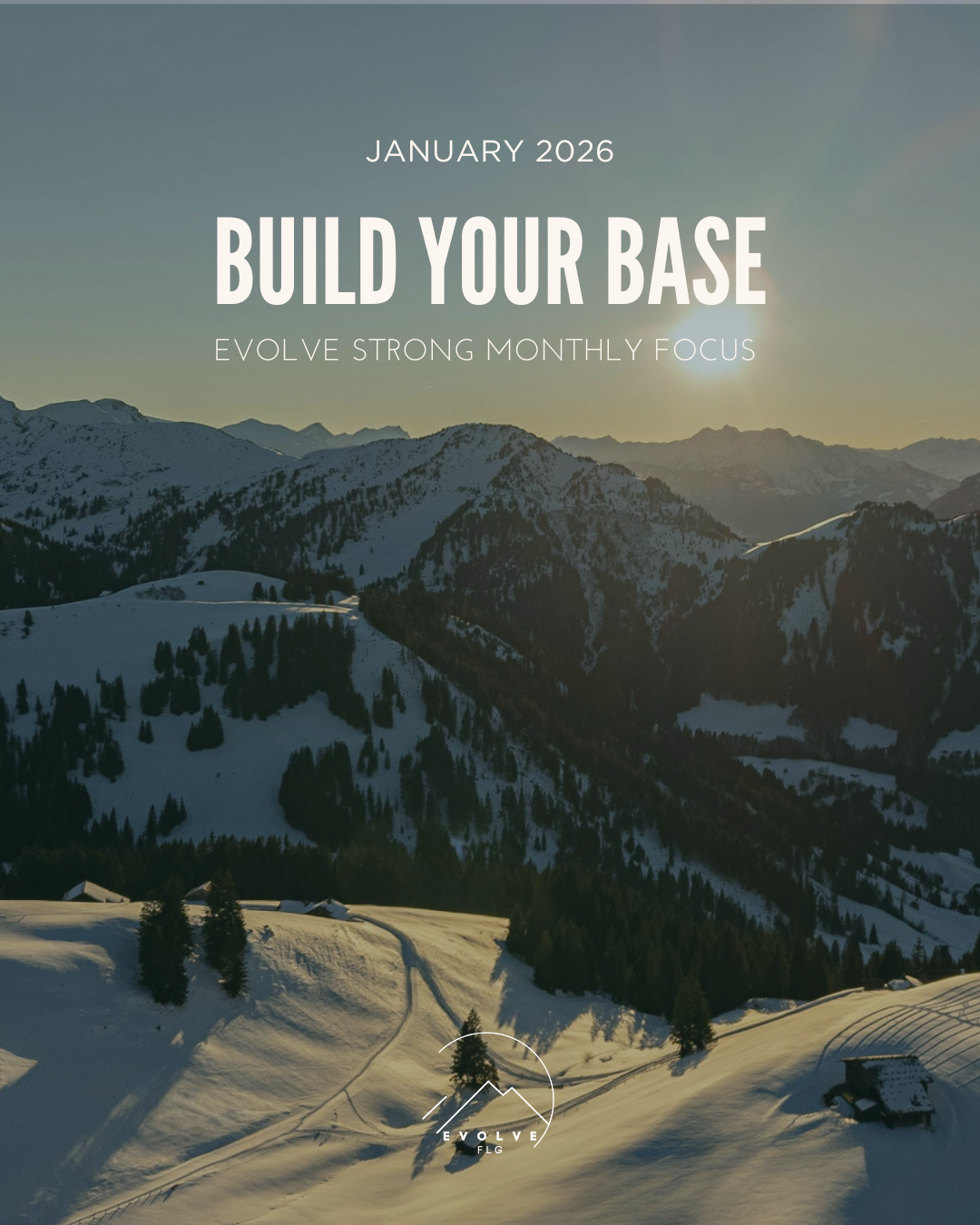
This January, our theme in the gym is Build Your Base—and we’re applying it not just to training, but also to how we think about a healthier, more life-giving New Year reflection.
Build implies creation—something generative that wasn’t there before.
Your makes it personal—what you want (or feel called) to build will be different from someone else.
Base suggests solidity—a foundation you can stand on, move from, and return to.
Building anything meaningful takes effort. But any building requires a strong foundation, and in the context of behavior change and personal growth, foundations are built from consistent, simple, sustainable changes.
And to continue with the construction metaphor: before a contractor builds anything, they usually need a site survey: a pause to take in the landscape and understand where they’re starting from.
In this context, a “site survey” can be journaling, meditation, or even just looking back at the calendar and photos to reflect on the year, and set intentions for the one ahead. Below, I’ve outlined a reflective practice that I’ll be doing this holiday season. Feel free to adapt it and make it yours.
**If you just want to learn about our January programming focus in the gym, you can scroll down to find that.**
Annual Reflective Practice
I’ve outlined a six step practice below that might help you to reflect on the past year, and chart a course into the year ahead.
For each step, I’ve listed the practice, followed by a brief explanation. If possible, use a physical notebook, and avoid using your phone during your reflection.
(Quick note: it’s hard to do this practice “wrong,” but we strongly recommend setting aside anything about weight or body size. Weight isn’t reliably linked to health outcomes when controlling for exercise and other lifestyle habits; we can’t control it the way diet culture suggests; weight-loss attempts often reduce exercise consistency; and weight loss can come with negative health tradeoffs like bone density and muscle loss. We want this to be productive and generative—building consistency, self-trust, and sustainable health.)
Step 1: Pause
Set aside some time: an hour on a weekend morning, a slow evening by a winter fire, or a quiet walk through the forest or desert. Leave your phone behind. Step away from screens and noise.
As you settle in, take five deep breaths. Feel the air enter your nose, fill your lungs, and expand your ribs. Pause, then exhale fully, letting a little tension go each time.
Slowing down, disconnecting, and slowing our breathing helps us to shift our nervous system out of a sympathetic, fight-or-flight state, and into a more reflective, parasympathetic state.
Step 2: Positive Reflection
What stands out as a few highlights from this year (even if it was a hard year)? How did you feel in those moments?
What were a few small, daily moments you don’t want to forget? How did they make you feel?
What did you learn in 2025 that felt interesting, meaningful, or important? Why?
Humans have a built-in negativity bias. Our brains and nervous systems are primed to recall negative thoughts, emotions, and experiences much more readily and powerfully than positive experiences. This was likely an adaptive evolutionary mechanism to help us avoid danger, but it can easily go into overdrive.
Even if it was a really hard year, try to write down at least 10–15 things—big or small. This pushes the brain past the obvious and helps counter negativity bias. Go beyond “what happened” and name the felt sense of it—your brain and body remember feelings more powerfully. And make it real: this is only for you, so don’t write down anything that isn’t authentic.
Step 3: Constructive reflection
What was challenging this year? (Notice the phrasing: not “What did I do wrong?”)
For each challenge:
Did I show up in a way aligned with my values?
Given what I knew and what I had capacity for, did I do my best?
What support, tools, or resources did I not have that would have helped?
In hindsight, can I find any meaning in it? Or did it just… suck?
Sometimes meaning does emerge from difficulty. We learn, grow, or feel proud of how we showed up. If so, consider what you want to carry forward.
But sometimes there isn’t meaning, or it hasn’t yet revealed itself. Sometimes things just suck. Naming that can invite more self-compassion and help you stop hunting for an answer that might not appear. In those seasons, the work may simply be moving through the darkness, leaning on others, honoring grief or pain, and trusting that the sun rises again eventually.
Step 4: Positive future visualization
Who do I want to become in 2026?
How do I want to feel in 2026?
How do I want the people around me to feel when they’re with me?
How can I apply what I learned in 2025 to how I live in 2026?
Alternative version that’s equally powerful and effective: “A Day In The Life, Six Months From Now,” from writer/educator Magdalena Ponurska
Nothing is static—we’re always becoming something new. But, before you plan the “doing,” explore the “feeling.” The world is full of people who accomplished everything they set out to do and still felt hollow or unhappy. What feelings do you want to carry through 2026? What feelings do you want others to experience around you? Examples:
Calm, content, peaceful
Excited, energetic, enthusiastic
Joyful, playful, curious
Accomplished, proud, respected
Warm, compassionate, loving
Skillful, helpful, capable
Step 5: Putting it into practice
What are 2–3 accessible, straightforward, and achievable practices that will help you move towards what you wrote above?
How can you ask for help? What support, resources, or structure do you need to succeed?
Practices are actions, not outcomes. We can’t fully control outcomes, but we can take consistent steps in the right direction.
Research consistently shows that when we’re motivated to change, we often start too ambitiously, struggle to follow through, and then quit. Counterintuitively, the smallest, easiest new action is often the most effective foundation.
And don’t be afraid to ask for support. The best in every field have coaches, mentors, or guides. In what areas could you benefit from that kind of help?
Example: I’m learning guitar as a complete beginner. My weekly intentions are simple: 1) Go to a weekly lesson; 2) Practice 15 minutes at least 4 times per week. That’s it. I trust my teacher to guide me, and I focus on consistency. But I don’t set the bar too high. A
Although I often practice longer than 15 minutes, if it’s late and I’m tired, 15 minutes still feels doable. If my goal were 30 minutes, I’d almost certainly practice less often. Human psychology is strange like that: a small part of us wants to commit to overachieving, but the rest of us becomes intimidated, and we end up ditching the plan altogether.
Step 6: Finish on a positive note
Who are the people who bring me joy, steadiness, delight, love, or warmth that I want to spend time with this year?
What is one small reason for hope, optimism, joy, delight, or contentment I can recognize in my life or community right now?
The world was often challenging in 2025, and may continue to be in 2026. Let’s close by counteracting our negativity bias and focusing on what matters close to home. Don’t worry here about current events or politics. Focus on your circle—your day-to-day, in-person world. That’s a place where we can actually make a difference.
Build Your Base: Gym Programming
We hope you find some value in that reflective exercise, and that it helps you build a foundation for the year to come.
But how does this all apply to the gym?!
This January, the gym also has a theme of Build Your Base. No weight-loss challenges. No unsustainable “New Year, new you” pressure. Just fun, effective programming to help you start the year strong.
In EVOLVE Strong, we’re applying the theme in three key ways:
1) Building muscle
Building muscle supports long-term health, reduces injury risk, and improves physical function. You might see or hear the term “hypertrophy,” which is just the scientific word for building muscle.
Some people worry about “getting bulky” or getting hurt. These are understandable concerns, but in practice, strength training is remarkably safe when coached well, and it’s very difficult to become “bulky” accidentally. (Click here to read more about strength training principles and common misconceptions.)
This month we will be focusing our strength blocks towards set and rep schemes that promote hypertrophy and building muscle. We’ll continue to use the training load calculator that we introduced in December to help you work at the right intensity with great technique.
2) Balance
A great foundation inherently creates stability from the ground up. Single leg balance is an important factor that helps promote fluid movement, stronger lifts, and fewer injuries.
Impaired balance can also contribute to persistent muscle tension, and even neck or back discomfort. Why’s that? Imagine that you are walking on an icy surface. What does your body reflexively do? Tense up and pull inward. Improving your balance can help to bring a greater sense of ease to everyday movements.
Balance tends to decline if we don’t practice it, so you’ll see single-leg work showing up regularly throughout the month.
3) Core stability
The “core” is one of the most misunderstood parts of training. We don’t treat it like a magic fix, but it is part of a strong foundation. The core isn’t just your abdominal muscles. It’s all of the muscles of the trunk, deep hip stabilizers, pelvis, and diaphragm. And a well-functioning core has nothing to do with a visible six-pack, or with doing 15-exercise ab circuit.
The core functions to stabilize the center pillar of our body, allowing the hips and shoulders to create powerful, dynamic movement.
In practice, “core training” includes:
Knowing how to brace, or create a stable torso
Learning to breathe while bracing (instead of holding your breath)
Applying that brace during real movements
Including 1–2 targeted core exercises per workout (the core muscles are just that, muscles. You wouldn’t, or shouldn't, do 15 bicep exercises in one workout, and the same is true of the core.)
Bonus: Commitment to consistency
You don’t need five workouts per week to be healthy or make progress. Most people do great with 2–3 EVOLVE-style workouts/week, plus a few cardio sessions (walks, hikes, runs, skiing—whatever you enjoy, and a simple intention to move a little each hour.
So, if you’re going to commit to anything this January, we encourage you to simply commit to attainable consistency. Two or three sessions a week, most weeks of the month, unless you’re traveling or sick.
EVOLVE Strong Monthly Challenges
Starting in January, we’re also introducing EVOLVE Strong Monthly Challenges. On Wednesdays and Saturdays during the last week of each month, the workout will include a specific challenge that highlights a different area of physical function. We have four challenges planned that repeat three times per year, so you can see how things progress over time.
These are not a “Presidential Fitness Test,” and not a reason to compare yourself to anyone else. They’re intended instead to be a fun way to track progress, and highlight metrics that are more meaningful than appearance or body weight.
So join us during the last week of January for the first Monthly Challenge!
As always, thank you for being part of the EVOLVE community. We hope you and your families have a wonderful end to 2025—and a strong, steady start to 2026.